
What Is the Hiroshima Peace Memorial Ceremony? — Prayers for “Peace” Passed Down Through the Generations
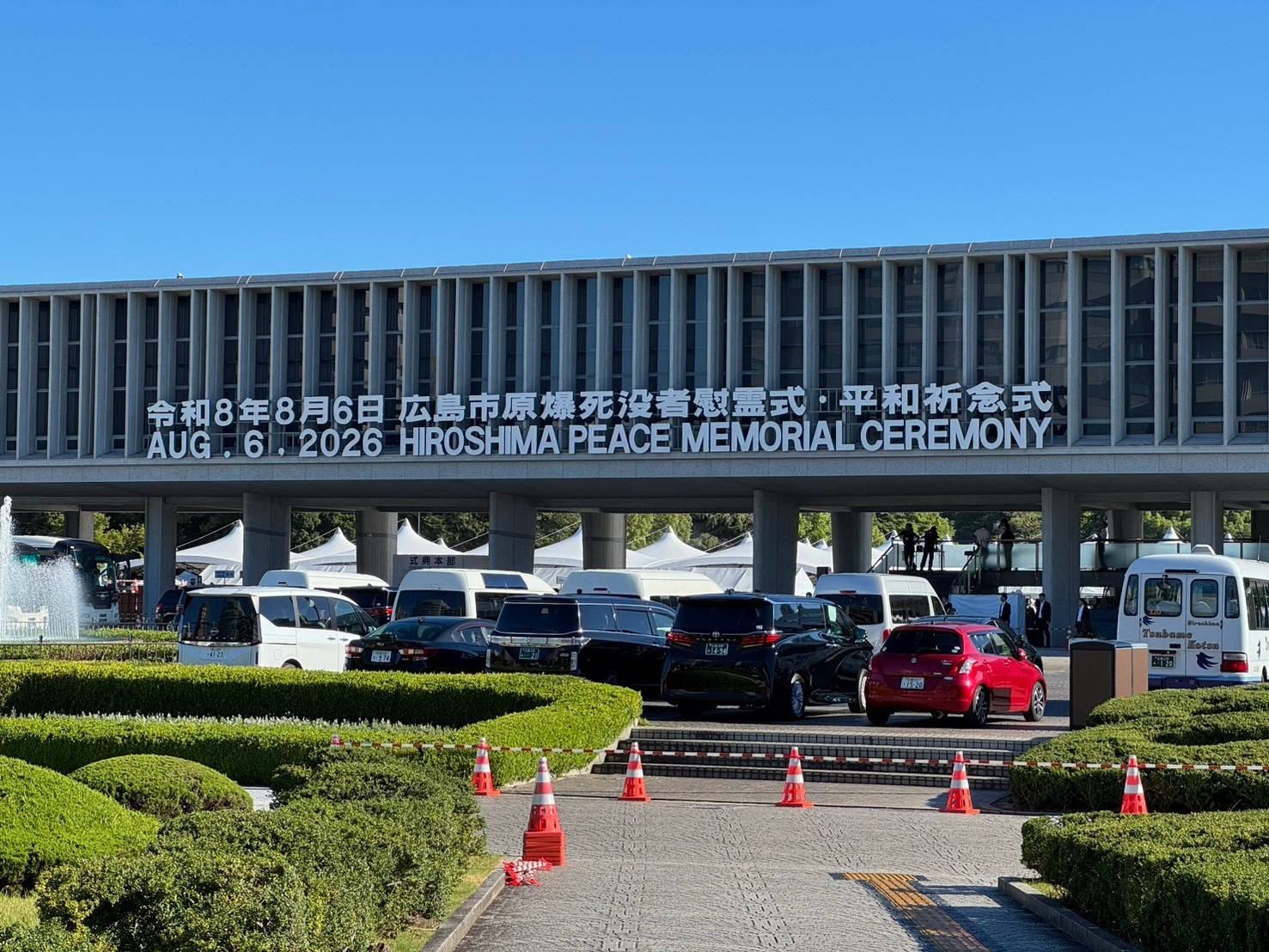
Every year on August 6, Hiroshima City holds the “Hiroshima City Memorial Service for the Victims of the Atomic Bombing and Peace Memorial Ceremony,” commonly known as the “Peace Memorial Ceremony.”
The year 2026 marks the 81st anniversary of the atomic bombing of Hiroshima. This year, I visited Peace Memorial Park in person and attended the Peace Memorial Ceremony.
People began gathering early in the morning, and in addition to attendees from within Japan, many foreign visitors were also present. Many dignitaries attended the ceremony, including the Prime Minister of Japan, the Governor of Hiroshima Prefecture, the Mayor of Hiroshima, the Chairperson of the Hiroshima City Council, and the leaders of various political parties. Furthermore, according to the program distributed at the event, attendees in 2026 came from countries and regions around the world—including Europe, the Americas, Asia, and Africa, as well as Taiwan and the Delegation of the European Union (EU)—which truly brought home the fact that Hiroshima’s prayers for peace are spreading globally, transcending positions and national borders.
In this article, I will not only describe the 2026 ceremony but also look back on how the Peace Memorial Ceremony began and how it has evolved into the significant event it is today, while sharing my impressions from visiting the site in person.
When did the Peace Memorial Ceremony begin?
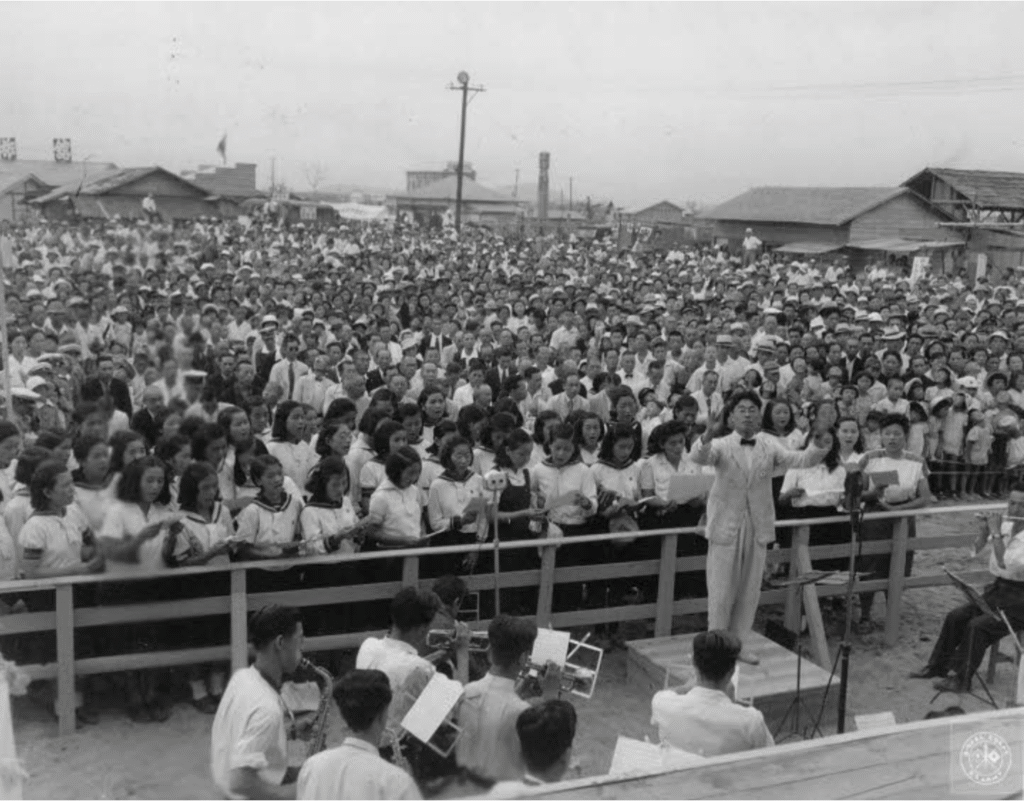
Source: Hiroshima Peace Media Center, “[Hiroshima Documents: 80 Years Since the Atomic Bombing] August 6, 1945–2025: August 1947, the First Peace Festival”(https://www.hiroshimapeacemedia.jp/?p=148751)
The “First Peace Festival,” held on August 6, 1947, served as the prototype for today’s Peace Memorial Ceremony.
Just two years after the atomic bombing, while the city still bore vivid scars, the event was held at “Peace Plaza” in Nakajima-Honmachi, organized by the Hiroshima Peace Festival Association. Approximately 2,500 citizens gathered at the venue, which symbolized the city’s efforts to rebuild from the scorched ruins.
At that time, a song for peace—the predecessor to today’s “Hiroshima Song of Peace”—was performed and sung in chorus, and Shinzo Hamai, then mayor of Hiroshima, read the “Peace Declaration” for the first time. Additionally, at 8:15 a.m., the “Bell of Peace,” which had been unveiled that year, was rung.
According to the City of Hiroshima, this Peace Festival was launched to convey to the world the strong wish of the citizens of Hiroshima—who were striving to rise from the ashes of the atomic bombing—to “establish eternal peace.” Since then, the Peace Declaration has been issued every year on August 6, and this tradition has been carried forward into the current Peace Memorial Ceremony.
In other words, the Peace Memorial Ceremony is not merely an annual tradition. It is a symbol of determination that has continued to convey to the world—through each era—what Hiroshima has chosen to remember and what kind of future it aims for as it rises from the ashes of the atomic bombing.
The “Declaration of Peace,” Which Has Evolved Over the Years
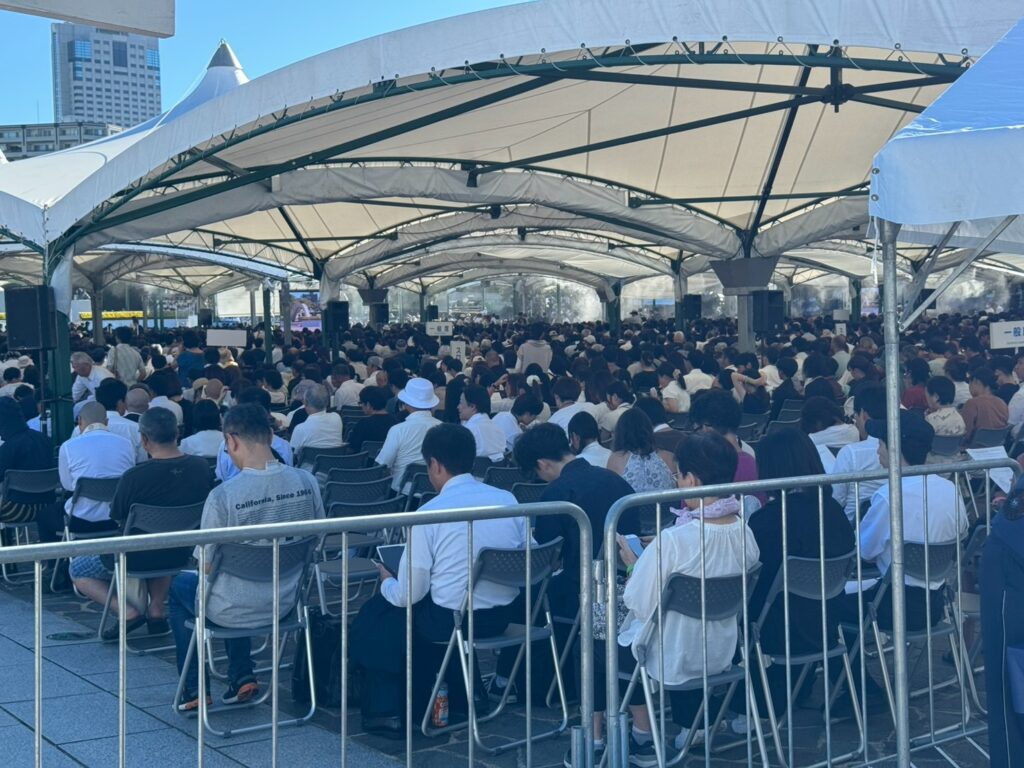
The “Peace Declaration,” issued annually, reflects the international situation of the time as well as the concerns of the citizens of Hiroshima.
For example, in 1956—against the backdrop of the First World Conference against Atomic and Hydrogen Bombs, held in Hiroshima the previous year—the phrase “ban on atomic and hydrogen bombs” appeared in the Peace Declaration for the first time.
In 1971, “peace education”—aimed at conveying the significance of war and peace to future generations—was explicitly stated, and in 1982, this evolved into initiatives in which cities around the world joined in solidarity to seek peace. The philosophy that led to the current “Mayors for Peace” also emerged from this trend.
Furthermore, from the 1990s onward, the themes of the Peace Declaration expanded beyond the issue of nuclear weapons to include passing on the true nature of the atomic bombings to future generations and fostering dialogue with people of different cultures and backgrounds.
What this history reveals is that the concept of “peace” has been deepened through a sincere engagement with the challenges of each era.
Beginning with mourning the victims of the atomic bombings, moving on to calling for the abolition of nuclear weapons, and then considering how to pass on these memories to future generations—the Peace Memorial Ceremony has continued for 81 years, evolving in its role throughout that time.
2026 Peace Memorial Ceremony
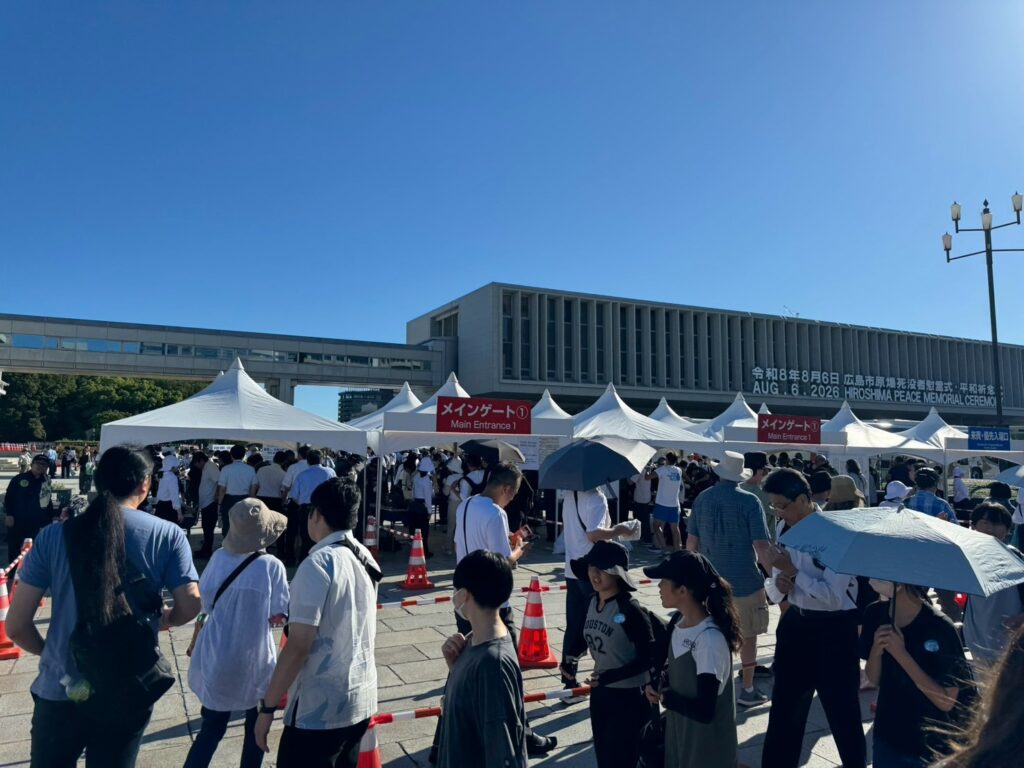
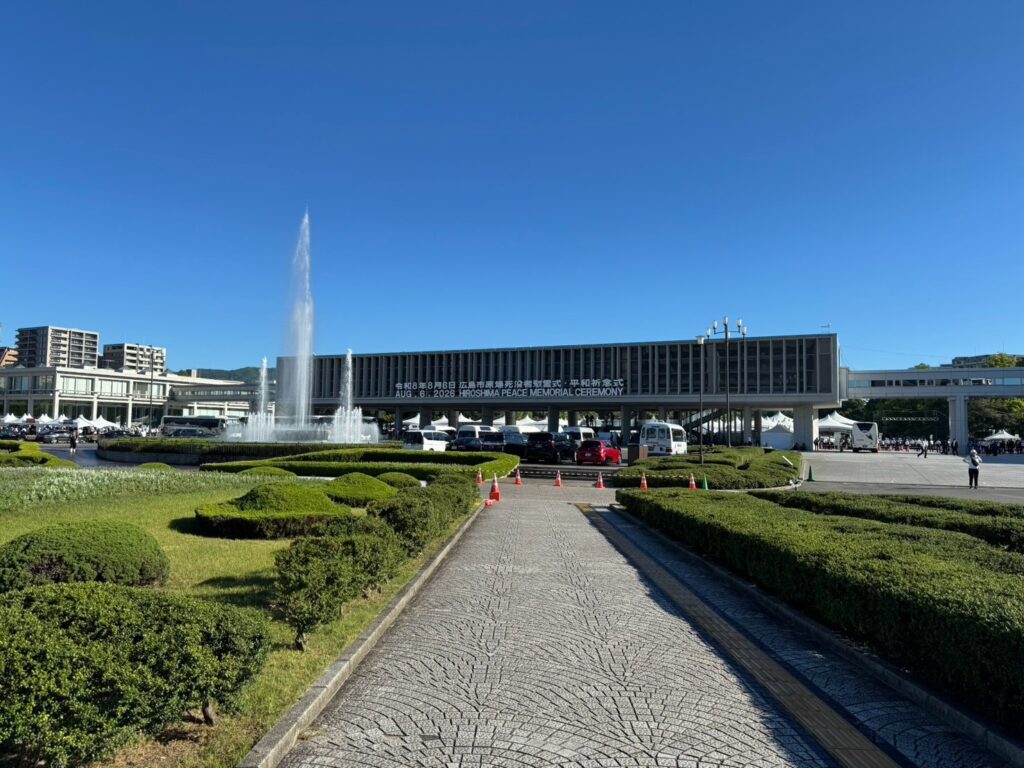
The 2026 Peace Memorial Ceremony was held at Peace Memorial Park from 8:00 a.m. to 8:50 a.m. on August 6.
The ceremony proceeded with the presentation of the Register of Atomic Bomb Victims, a commemorative address, and the laying of floral tributes, followed by the ringing of the “Peace Bell” at 8:15 a.m.—the exact time the atomic bomb was dropped. Following a one-minute moment of silence observed by all attendees, a “dove release” took place, in which doves were released into the sky as a symbol of hopes for peace. This was followed by the “Peace Declaration” delivered by the Mayor of Hiroshima, the “Pledge for Peace” recited by a child representative, and addresses by the Prime Minister of Japan, the Governor of Hiroshima Prefecture, and the United Nations Secretary-General, among others. The ceremony concluded with a chorus of the “Hiroshima Song of Peace.”
What left a particularly strong impression on me was the moment of silence at 8:15 a.m.
There were many cicadas in Peace Memorial Park, and even during the moment of silence, their powerful chirping, evoking the feeling of summer, echoed throughout the park. The lively chirping of the cicadas resonated among the people who had quietly closed their eyes. Their vitality stood in poignant contrast to the many lives that, 81 years ago, could not survive even though they wanted to live in this very place.
At the same time, as I listened to that powerful voice of life, I was reminded of the people who survived the devastating damage caused by the atomic bomb and went on to rebuild postwar Hiroshima.
Lives lost and lives that continue today. As I offered a moment of silence, reflecting on these two realities side by side, I found myself thinking deeply about the everyday life lost to the atomic bomb and the path Hiroshima has taken since then. I believe this is one of those experiences that can only be felt by standing on the ground itself—something that cannot be gained simply by learning history as “events of the past.”
“Passing Down Memories”—A Role Shouldered by Children
At the 2026 ceremony, children could be seen handing out pamphlets at the venue.
In addition, during the ceremony, child representatives recite the “Pledge for Peace.”
This “Pledge for Peace” was first introduced in 1995, marking the 50th anniversary of the atomic bombings. It began when children from around the world announced their discussions from the “Children’s Peace Gathering” as a declaration of their commitment to peace. Since then, it has continued as an opportunity for children to reflect on peace and express their thoughts in their own words.
At the 2026 ceremony, two local sixth-graders (Yu Kakizaki and Kazuki Kono) took the stage. Their pledge began with the words, “Tattered school uniforms, blackened lunchboxes—these are evidence of a life lived in the ordinary everyday.” As the last generation able to hear firsthand accounts of the atomic bombings, they spoke powerfully about not turning a blind eye to this sad reality, emphasizing the importance of “imagining others’ feelings and respecting our differences” and “how each person’s small actions can contribute to peace.”
As the atomic bomb survivors continue to age, “how to pass on their memories to the next generation” has become a critical issue for Hiroshima. With younger generations participating in activities such as recording names in the memorial register, the Peace Memorial Ceremony has evolved into a venue where we, living in the present, receive the “memories of the past” from the survivors and pledge to pass them on to the future.
How to Actually Attend the Peace Memorial Ceremony: Seat Types and the Day’s Schedule
For those who would like to actually attend the Peace Memorial Ceremony, we’ll introduce the types of seats and the day’s schedule based on information for the 2026 event.
[General Seating: No Reservation Required; First-Come, First-Served on the Day of the Event]
At the 2026 Peace Memorial Ceremony, approximately 7,000 seats were set up at the main venue in Peace Memorial Park, of which about 1,200 were general seats available to the public.
General seating is not reserved in advance; it is first-come, first-served. Therefore, general visitors do not need to purchase tickets in advance.
However, admission will be restricted once capacity is reached. In 2026, admission began at 6:00 a.m., and when I visited, the general seating area was already full by around 7:30 a.m. If you wish to attend, we recommend heading to the Peace Memorial Park as early as possible.
[Advance-Reservation Seats for International Visitors]
In 2026, approximately 500 “seats for international visitors” were set aside for international visitors and their companions who require simultaneous interpretation in English.
Unlike general seating, these seats are available by advance reservation on a first-come, first-served basis. The registration period for 2026 runs from 9:00 a.m. on June 1 to 5:00 p.m. on June 26, and applications can be submitted via the reservation form on the Hiroshima City website. Each group may register up to 20 people, including a maximum of 3 accompanying persons.
Seats for international visitors are equipped with English simultaneous interpretation receivers; those able to attend the ceremony in Japanese should use the general seating area.
[Seats Requiring Advance Reservations, Such as Local Government Seats]
In addition, “local government seats” are reserved for local government officials. Approximately 2,500 seats were made available for 2026, and applications were accepted through local governments from May 14 to June 17. While these seats are not available to the general public, the Peace Memorial Ceremony provides different seating arrangements depending on the attendees’ status.
[Be Aware of Access Restrictions on the Day of the Ceremony]
On the day of the ceremony, access restrictions will be in place in parts of Peace Memorial Park, and bag checks and metal detector screenings will be conducted. In 2026, as a safety measure, access restrictions were enforced from 5:00 a.m. to 9:00 a.m. It is advisable to avoid bringing large bags or suitcases and to arrive with plenty of time to spare.
Additionally, on the day of the ceremony, the “Attendee Seating Entrance” to the seating area is located on the south side of the park (toward Heiwa-odori Avenue), which may require a significant detour depending on your approach. When I approached from the north side, where the Atomic Bomb Dome is located, I had to make a wide loop around the park to reach the seating entrance. If this is your first time attending, I recommend checking the location of the Attendee Seating Entrance and the access route in advance.
[How to Attend at an Indoor Sub-Venue]
For those who say, “I’d like to attend the ceremony, but I’m concerned about being outdoors in the middle of summer,” an indoor sub-venue is also an option.
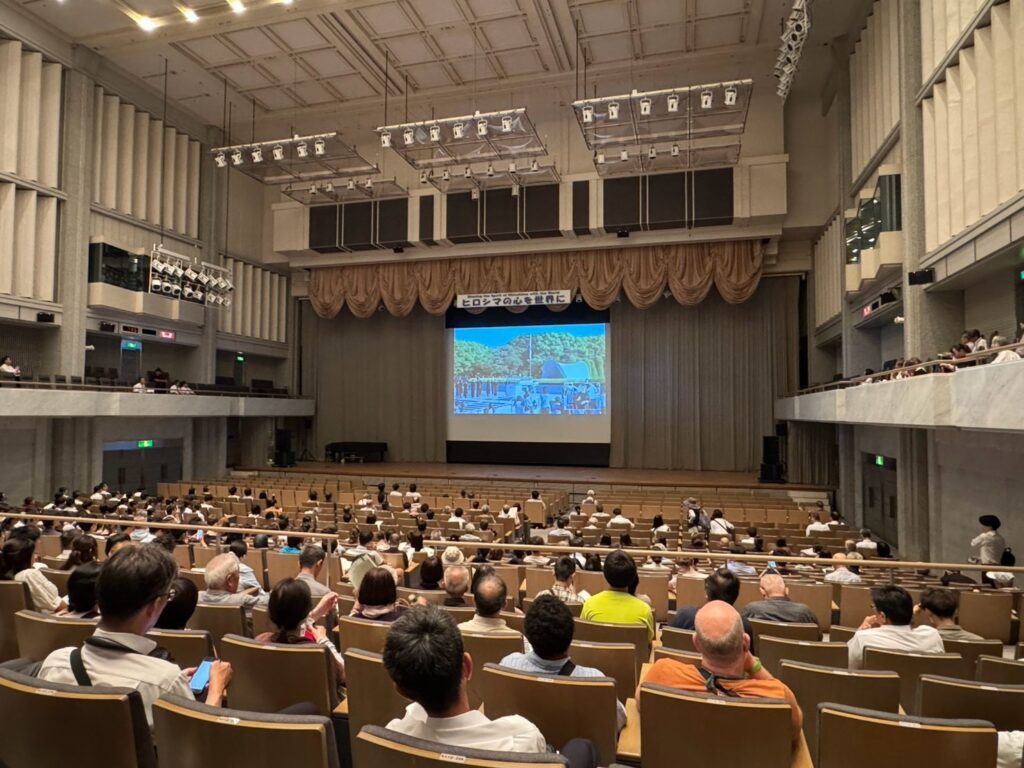
In 2026, approximately 2,200 indoor seats were set up in Phoenix Hall and Himawari Hall at the Hiroshima International Conference Center within Peace Memorial Park, and the ceremony was simulcast there. Since attendees can participate in an air-conditioned indoor setting, these venues are particularly accessible for the elderly and those concerned about the heat.
When I visited, I saw that many people had gathered at the sub-venues as well. At 8:15 a.m., a moment of silence was observed just as it was at the main venue, and warm applause broke out at key moments during the ceremony, creating a space where people could share their prayers with a sense of unity.
Please note that the ceremony dates and times, seat types, reservation methods, and admission restrictions are subject to change from year to year. When planning to attend, be sure to check the latest information on the Hiroshima City official website for that specific year.
If you’re visiting Hiroshima on August 6, stay at Hotel Small World
The Peace Memorial Ceremony on August 6 begins at 8:00 a.m., and the general seating area starts to fill up early in the morning. Therefore, if you are traveling from a distance, it is safest to arrive in Hiroshima by the day before and stay overnight.
However, on August 5—the day before the ceremony—hotels and other accommodations in Hiroshima tend to be very crowded and often fill up quickly. If you plan to attend, we recommend securing your room as early as possible.
In addition, visiting the Peace Memorial Park, the Atomic Bomb Dome, and the Hiroshima Peace Memorial Museum the day before to learn about Hiroshima’s history will help make the moment of prayer during the ceremony that day a more profound experience.
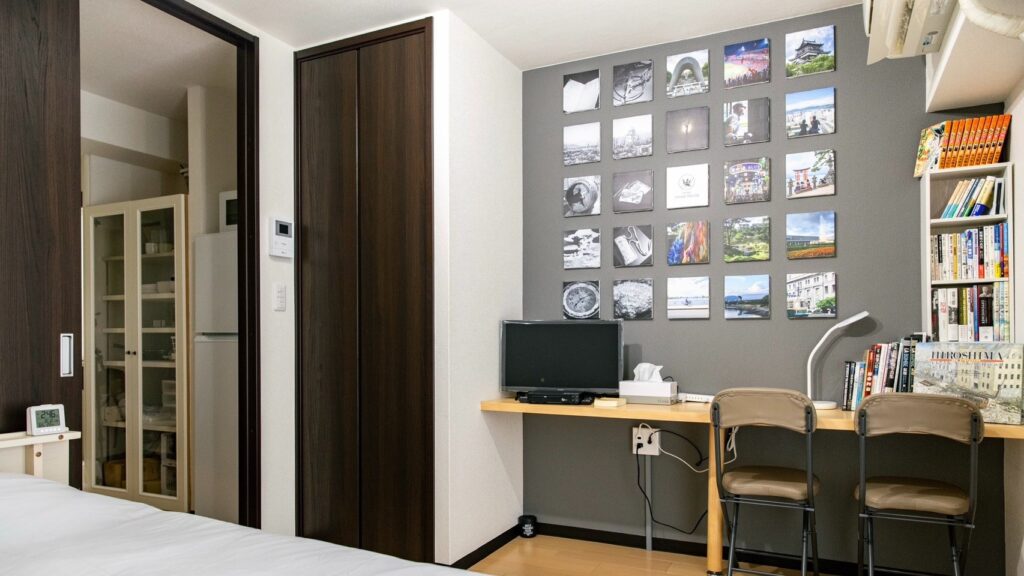
Hotel Small World is a hotel built around the concept of “peace.” Guest rooms are equipped with materials and reference books that provide insight into the tragedies of the past and the current state of Hiroshima, which has recovered from them. A distinctive feature of our hotel is the opportunity to learn about Hiroshima’s history while relaxing here, and then visit Peace Memorial Park the following morning.
Whether you’re visiting Hiroshima on the special day of August 6 or simply wish to reflect on “peace” during your summer trip to Hiroshima, we invite you to spend a special time at Hotel Small World.
Summary
Eighty-one years ago, Hiroshima lost so much to a single atomic bomb; today, it has become a city symbolizing peace, drawing people from all over the world.
Mourning the victims of the atomic bombing.
Conveying the true reality of the bombing.
Calling for the abolition of nuclear weapons.
And passing on these memories to future generations.
Visiting Hiroshima on August 6 is not only an opportunity to learn about history, but also to actually walk through the city as it is today and witness the people who live there and those who are working to spread the message of peace.
By learning about what the Peace Memorial Ceremony has passed down over the years, perhaps we can also reflect anew on our own daily lives here in this city today.


Recommend
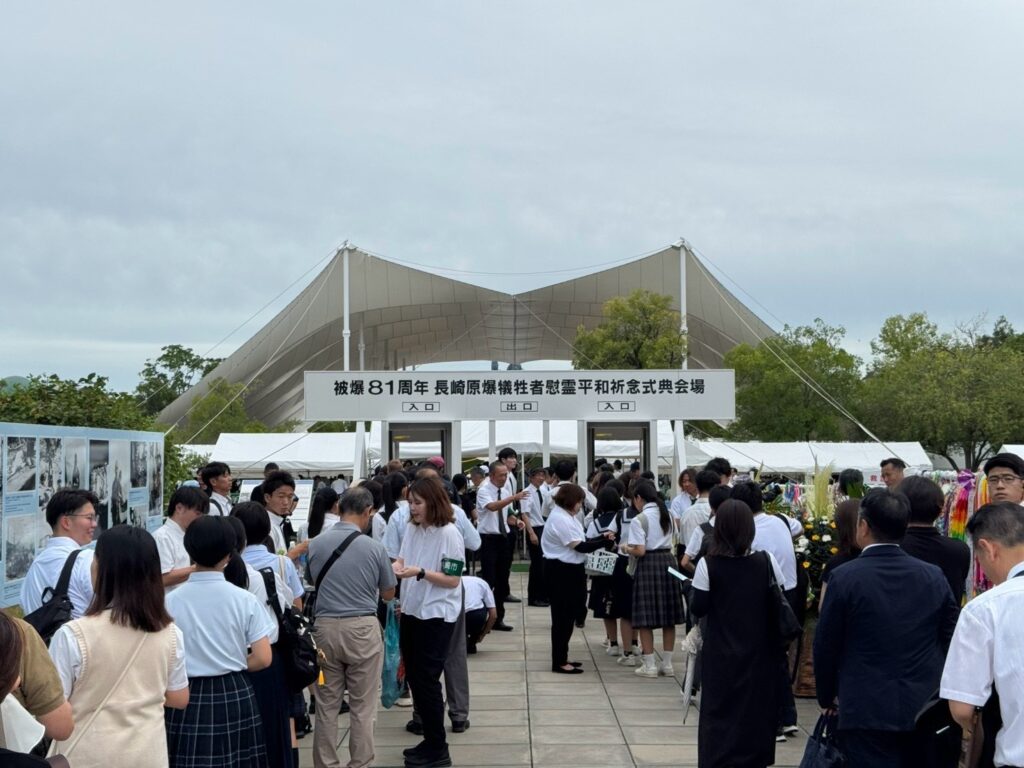
What Is the Nagasaki Peace Memorial Ceremony? — A Prayer for Peace from “The Last City to Suffer an Atomic Bombing”
About one month after the atomic bombing, another tragedy struck Hiroshima: the “Makurazaki Typhoon”
It’s Not Just the Atomic Bomb: The 400-Year History of the City of Hiroshima