Learning About the Hiroshima Atomic Bombing Through “HIROSHIMA: A Tragedy Never to Be Repeated”
There are various ways to learn about the atomic bombing of Hiroshima, including testimonies from survivors, photographs, videos, and literary works.
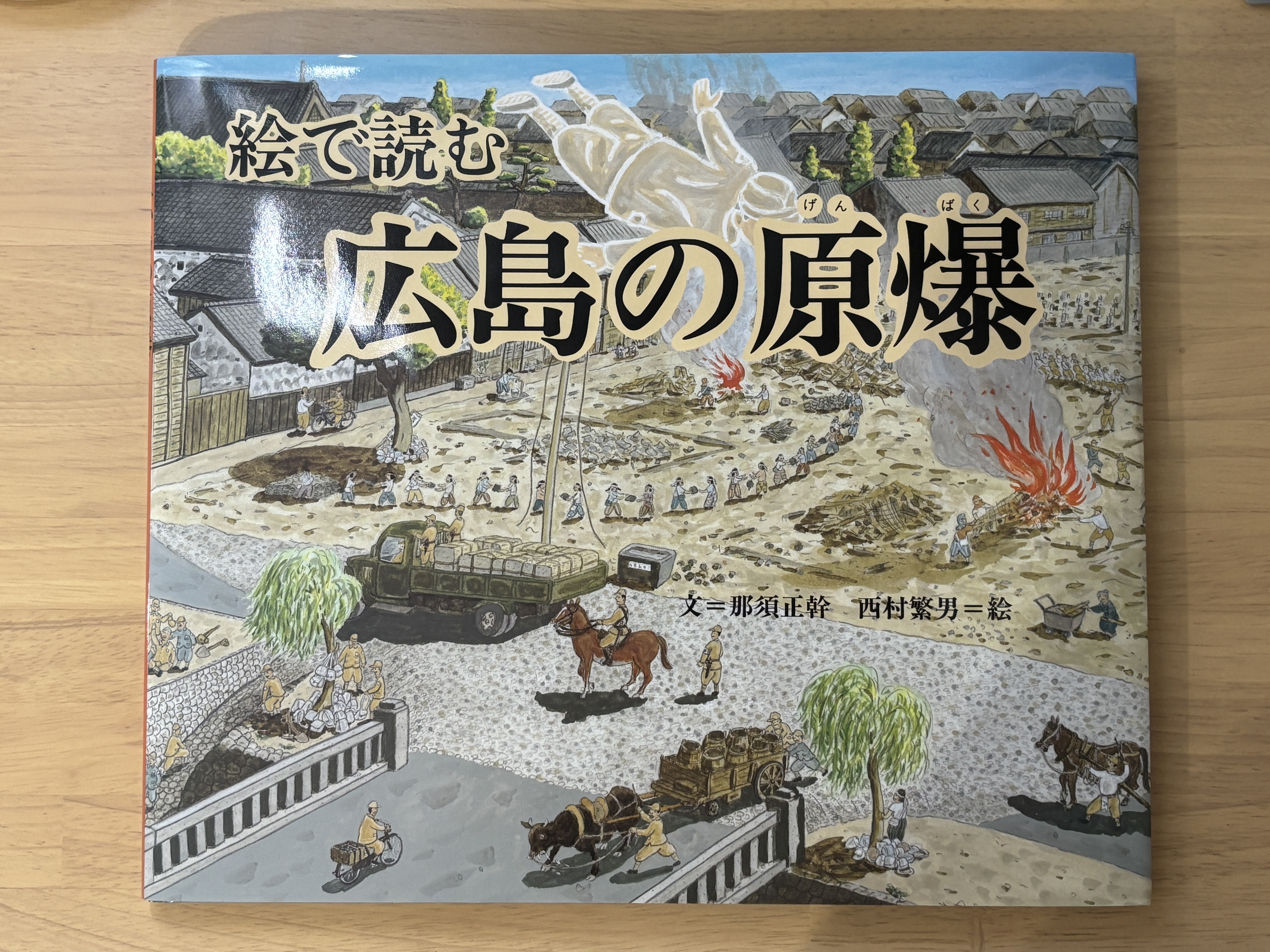
Among these, Masamoto Nasu’s HIROSHIMA: A Tragedy Never to Be Repeated covers a wide range of topics—not only the damage caused by the atomic bomb in Hiroshima, but also what the city looked like at the time, people’s daily lives, the background leading to the development of the atomic bomb, the mechanics of nuclear weapons, and the effects of radiation.
Published in 1995, the book features text by children’s literature author Masamoto Nasu and illustrations by artist Shigeo Nishimura. Through its text and illustrations, this book offers a multifaceted understanding of the Hiroshima atomic bombing. An English edition is also available, allowing readers to explore the subject in both Japanese and English.
In this article, we’ll introduce HIROSHIMA: A Tragedy Never to Be Repeated, a book that provides a comprehensive understanding of what happened in Hiroshima through history, science, and depictions of the city at the time.
Masamoto Nasu, the author, who was himself a survivor of the atomic bombing of Hiroshima
Masamoto Nasu, who wrote the text for, HIROSHIMA: A Tragedy Never to Be Repeated, was born in Hiroshima City in 1942 and was exposed to the atomic bomb at the age of three.
This book does not merely depict Mr. Nasu’s own experiences; rather, drawing on survivor testimonies and other sources, it portrays the events that unfolded in Hiroshima from a broad perspective.
Consequently, the book is structured not to follow a narrative centered on the experiences of a specific individual, but to provide an understanding of the damage inflicted on the city of Hiroshima as a whole.
Additionally, Shigeo Nishimura, who created the illustrations, conducted on-site research in Hiroshima and meticulously depicted the buildings, cityscapes, and people of that era.
One of the book’s distinctive features is that, while taking the author’s own experience of the atomic bombing as its starting point, it portrays the overall situation of the bombing in Hiroshima based on a variety of historical materials and testimonies.
Learning About the Atomic Bomb from Various Perspectives
This book not only describes the events that took place in Hiroshima on August 6, 1945, but also explores the background leading to the creation of the atomic bomb and the state of Hiroshima at that time.
It introduces the circumstances that led to the atomic bombing of Hiroshima, while touching on the international situation during World War II and the development of nuclear weapons.
Furthermore, it covers the mechanics of nuclear weapons, as well as the effects of the heat rays, blast waves, and radiation generated by the explosion.
By not only learning about the damage caused by the atomic bomb in Hiroshima but also examining its background and scientific aspects, readers can gain a broader perspective on the atomic bomb.
Rather than focusing solely on the circumstances of the bombing, this book addresses the topic from multiple angles—including history and science—which is a distinctive feature of HIROSHIMA: A Tragedy Never to Be Repeated.
Hiroshima at That Time, as Seen Through Art
Another major feature of this book, as the title suggests, is that readers can understand the content through the “illustrations.”
The illustrations by Shigeo Nishimura depict in fine detail the streetscapes, buildings, and people of Hiroshima at that time.
By looking at the illustrations, readers can vividly visualize the cityscape—which is difficult to imagine from text alone—as well as the changes Hiroshima underwent as a result of the atomic bombing.
Furthermore, topics that might be difficult to grasp through words alone—such as the mechanics of the atomic bomb and the effects of radiation—are explained through a combination of illustrations and text.
While the term “picture book” might bring to mind simple content intended for children, this book covers a wide range of topics, from historical background to scientific concepts.
As a result, it serves as an excellent resource for those learning about the atomic bomb for the first time to gain a comprehensive understanding, as well as for those who have already studied the subject to reexamine what they’ve learned from a different perspective.
Take some time to learn about Hiroshima at Hotel Small World
Hotel Small World was built with “peace” as its central theme. To help you take a moment—even if just a brief one—during your stay to reflect on the events that took place in Hiroshima and the meaning of peace, we have provided various materials in the guest rooms regarding Hiroshima’s history, the atomic bombing, and peace.
In addition to books, we also have photographs and DVDs available to help you learn more about Hiroshima. You can also read the book HIROSHIMA: A Tragedy Never to Be Repeated in your room.
After sightseeing in Hiroshima, why not take a little time during your trip to leisurely browse through these materials? It might also be a good idea to reflect on the places you visited that day through the books and photographs.
Summary
There are many ways to learn about Hiroshima’s history and the message of peace. One such way is to explore the records that have been preserved, such as books, photographs, and videos.
We hope your stay at Hotel Small World will serve as an opportunity to learn about the events that took place in Hiroshima and the history of this city.