Okuno Island—Layers of Memory Floating in the Seto Inland SeaOkuno Island
Okuno Island is a small island with a circumference of approximately 4.3 kilometers, floating amidst the gentle waves of the Seto Inland Sea. Belonging to Takehara City in Hiroshima Prefecture, the island is known as “Rabbit Island” due to the hundreds of wild rabbits that live there, attracting many visitors from both Japan and abroad.
The blue sea glistening in the sunlight and rabbits playfully hopping through the grass. This heartwarming scene instantly soothes the hearts of visitors. However, as you walk further, the massive concrete ruins that appear throughout the island quietly reveal another side of this place.
The current peaceful atmosphere and the heavy history of poison gas production that once took place here. As we walk through Okuno Island, where these two contrasting realities coexist, we explore what we can learn from the past and how we should apply those lessons to the future.
The Coast of Tadanoumi and the Industrial Legacy Woven by Aohata
Your journey to Okuno Island begins in Tadanoumi, Takehara City—the gateway to the island from the Honshu side. As you step off the JR Kure Line at Tadanoumi Station, you’ll find yourself immersed in the leisurely pace of life unique to the Seto Inland Sea.
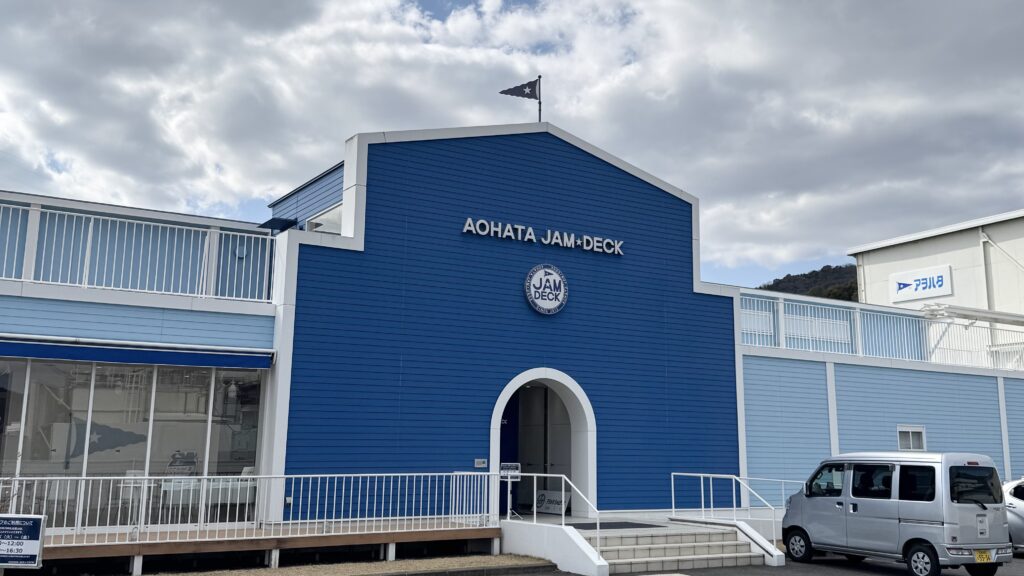
Before heading to Tadanoumi Port, the “Aohata Jam Deck” catches your eye near the station. Marked by an orange sign, this facility offers a chance to learn about the history of Aohata Co., Ltd.—a pioneer in Japan’s jam manufacturing industry—and the process of making jam.
The company that would become Aohata was founded in this area in 1932 (Showa 7). It is said to have begun by focusing on the abundant citrus fruits nurtured by the Seto Inland Sea’s mild climate, starting with the production of canned mandarin oranges and orange marmalade. Tadanoumi, which had long flourished as a key hub for maritime transportation, took on the character of a tranquil industrial town where food processing and similar industries took root in the modern era.
From the dedicated studio at Aohata Jam Deck, the sweet aroma of simmering fruit wafts through the air. The peaceful industrial heritage that stretches along the Tadanoumi coastline and the history of Okuno Island, which lies ahead. The coexistence of these two distinct histories, separated by just a few kilometers of sea, is a defining geographical feature of this region.
Encounters with Rabbits and the Landscape of the “Present”
We board the ferry bound for Okuno Island from the pier at Tadanoumi Port. Standing on the deck with the sea breeze on our cheeks, the water glistens as it reflects the sunlight, and the panoramic beauty of the Seto Inland Sea—with its countless overlapping islands—unfolds before us.
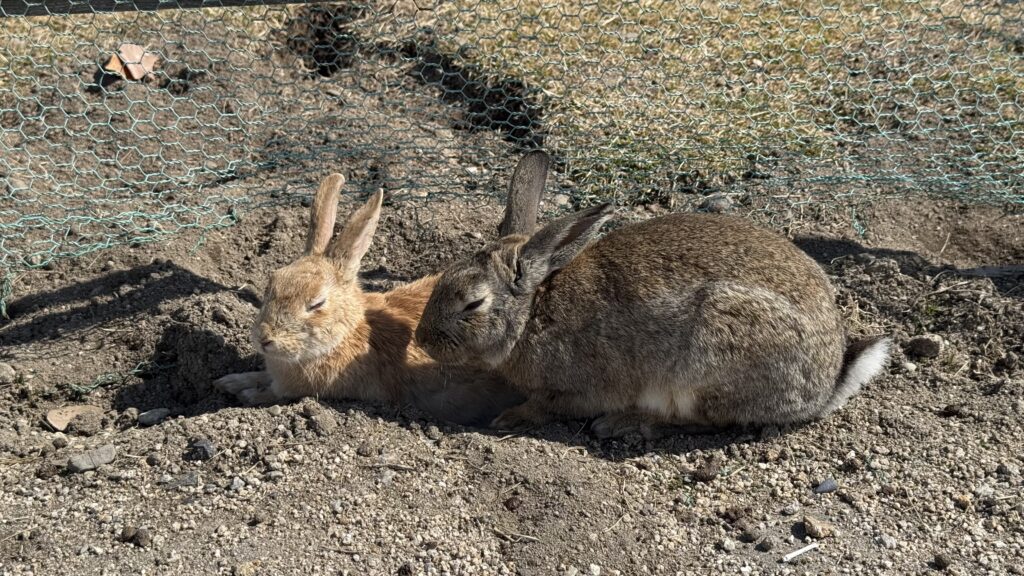
After a short 15-minute voyage, we arrive at the pier on Okuno Island, where we find ourselves in a completely different world. The moment you step off the boat, rabbits with innocent expressions come running right up to your feet. You’ll see them devouring vegetables offered by tourists with pure delight, or squinting their eyes as they bask in the sun. This atmosphere, which permeates every corner of the island, is the very embodiment of peace.
There are several theories regarding why so many rabbits live on this island. One theory suggests that rabbits kept as laboratory animals at a wartime facility—which will be discussed later—went feral after the war. Another theory posits that in 1971 (Showa 46), after the island had been completely uninhabited for a time, several rabbits kept at a local elementary school were released onto the island. They then bred in an environment with few natural predators, eventually reaching their current numbers.
Neither theory goes beyond speculation, and it is impossible to definitively determine the exact lineage of the current rabbits as a matter of historical fact. However, regardless of their origin, the fact that they exist today on Okuno Island as a symbol of “peace” remains unshakeable.
The History of “Poison Gas Production” Erased from the Map
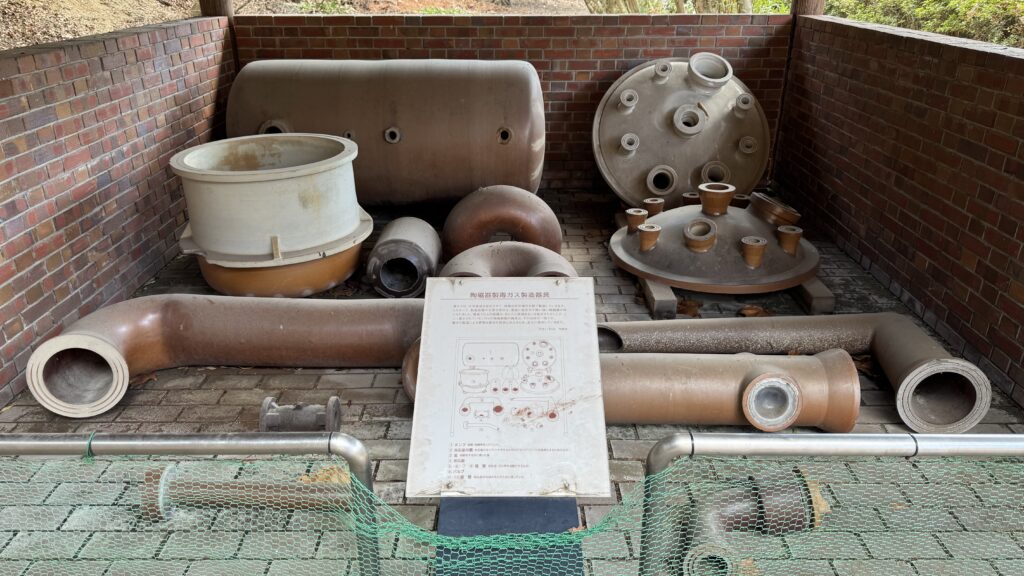
As you walk past the lawn where rabbits hop about and onto the path that circles the island, the landscape suddenly changes. Emerging from among the trees are numerous massive ruins with exposed concrete.
When discussing the history of Okuno Island, the 15-year period from 1929 (Showa 4) to 1945 (Showa 20) was a time when the very purpose of the island’s existence was entirely different. During this period, the entire island was placed under the control of the Japanese Army and operated as the “Tokyo Second Army Ordnance Factory, Tadanoumi Weapons Manufacturing Plant,” where large-scale production of poison gas took place. To maintain military secrecy, Okuno Island was erased from public maps of the time. Although it physically floated in the Seto Inland Sea, it was treated as a “non-existent island” in official records.
Background and Scale of Production
The Geneva Protocol, adopted in 1925 (Taisho 14), prohibited the use of chemical weapons in warfare. However, the prevailing international and legal interpretation at the time was that the manufacture and possession of such weapons were not prohibited, and the Japanese Army proceeded with the construction of facilities and production in strict secrecy.
Records indicate that Okuno Island was chosen because, as an island surrounded by sea, it was easy to maintain secrecy, and because its proximity to Honshu offered certain conveniences in terms of transporting materials and securing labor.
The main chemical substances manufactured on the island were as follows.
It is estimated that over the 15 years leading up to the end of the war, the total amount of poison gas produced on Okuno Island reached approximately 6,600 tons. To support this scale of production, the entire island functioned as a single massive factory.
Working Conditions and Documented Facts
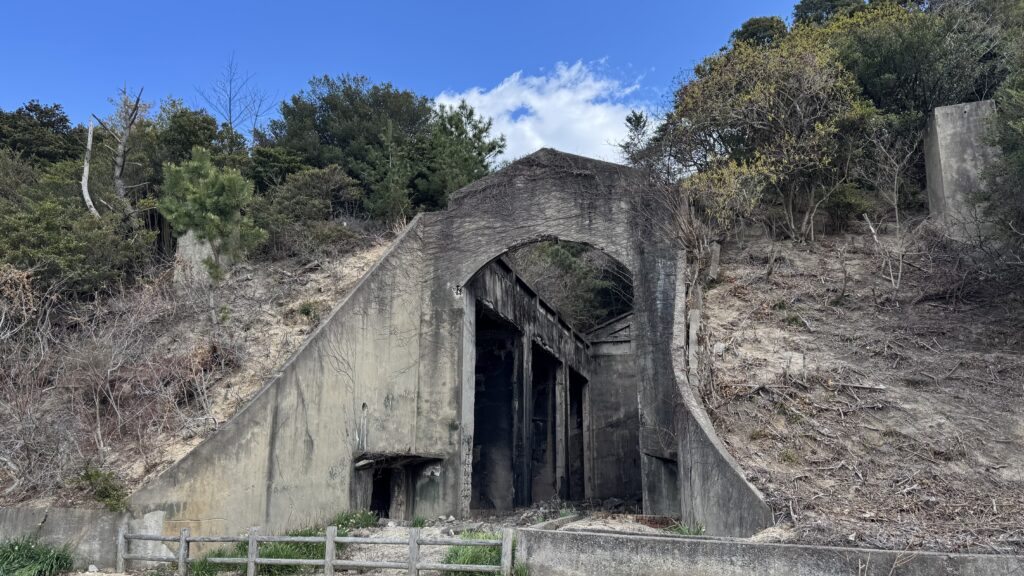
At its peak, the number of personnel involved in poison gas production reached several thousand. This group included not only military personnel but also many civilian workers from neighboring regions, as well as students who were mobilized due to labor shortages toward the end of the war.
In the working conditions of that era, the performance of protective clothing and gas masks was far from sufficient by modern standards. Records indicate that gas leaks occurred during the manufacturing process in environments with inadequate airtightness and ventilation systems. Furthermore, it is believed that many workers suffered health problems, including respiratory diseases, due to the inhalation of trace amounts of the gas and skin contact during routine work.
Records indicate that in some cases, workers were made to work without being clearly informed of what they were manufacturing, under strict confidentiality agreements, and the government continues to provide medical support to former employees to this day.
What the Concrete Ruins Reveal
As you walk along the route that circles the island (approximately 3.3 kilometers), you’ll find numerous ruins that silently tell the story of this history.
【Power Plant Ruins】
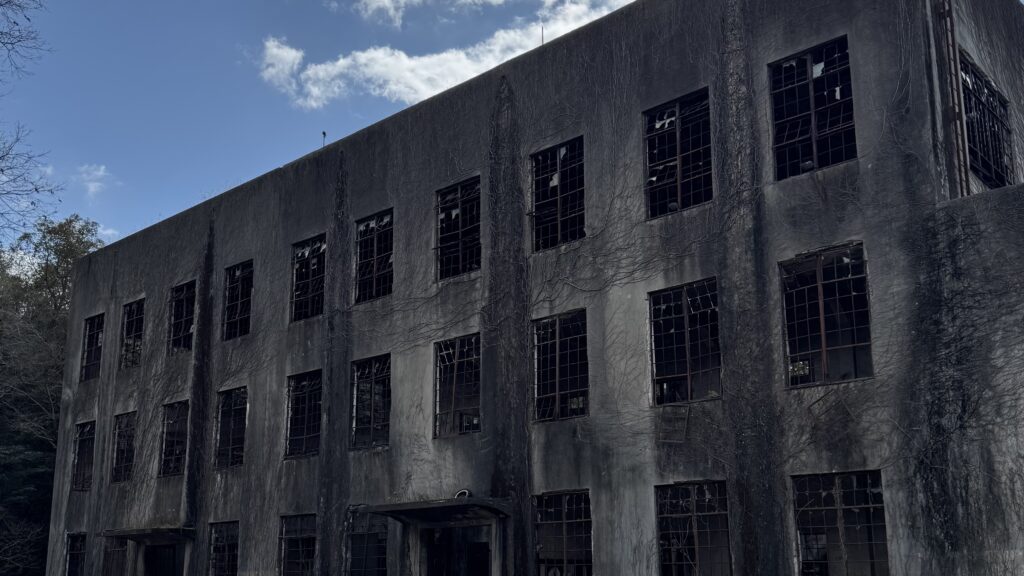
The “power plant ruins” in the northern part of the island command an overwhelming presence. The process of manufacturing poison gas required enormous amounts of electricity, particularly for the electrolysis used to extract chlorine, the raw material. This massive concrete structure was built to supply that electricity. Today, the machinery inside has been removed, leaving only the ivy-covered exterior walls, the tall chimney, and the decaying window frames. The vastness of the now-empty interior speaks to just how massive the facility was at the time.
【Site of a Former Poison Gas Storage Facility】
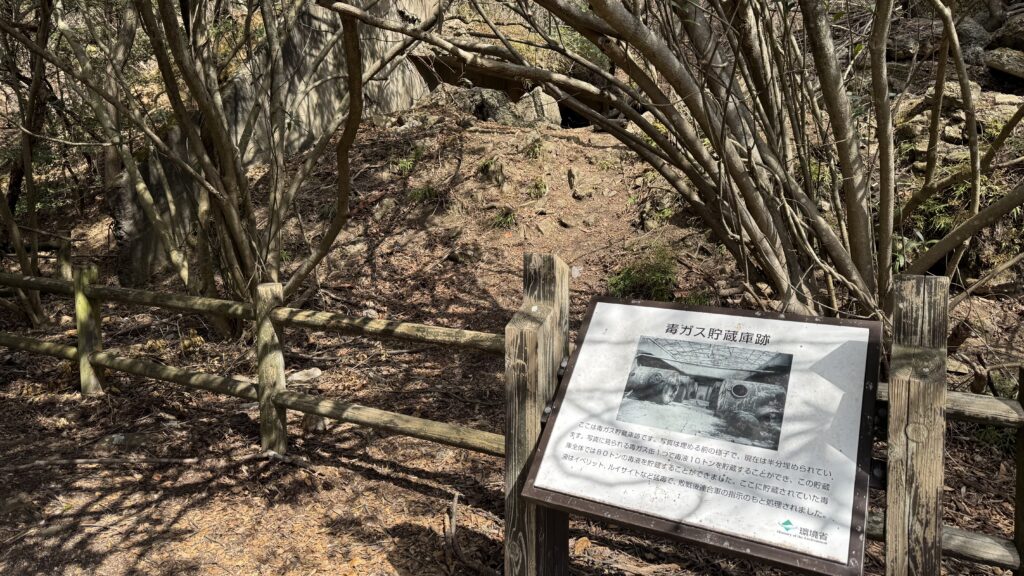
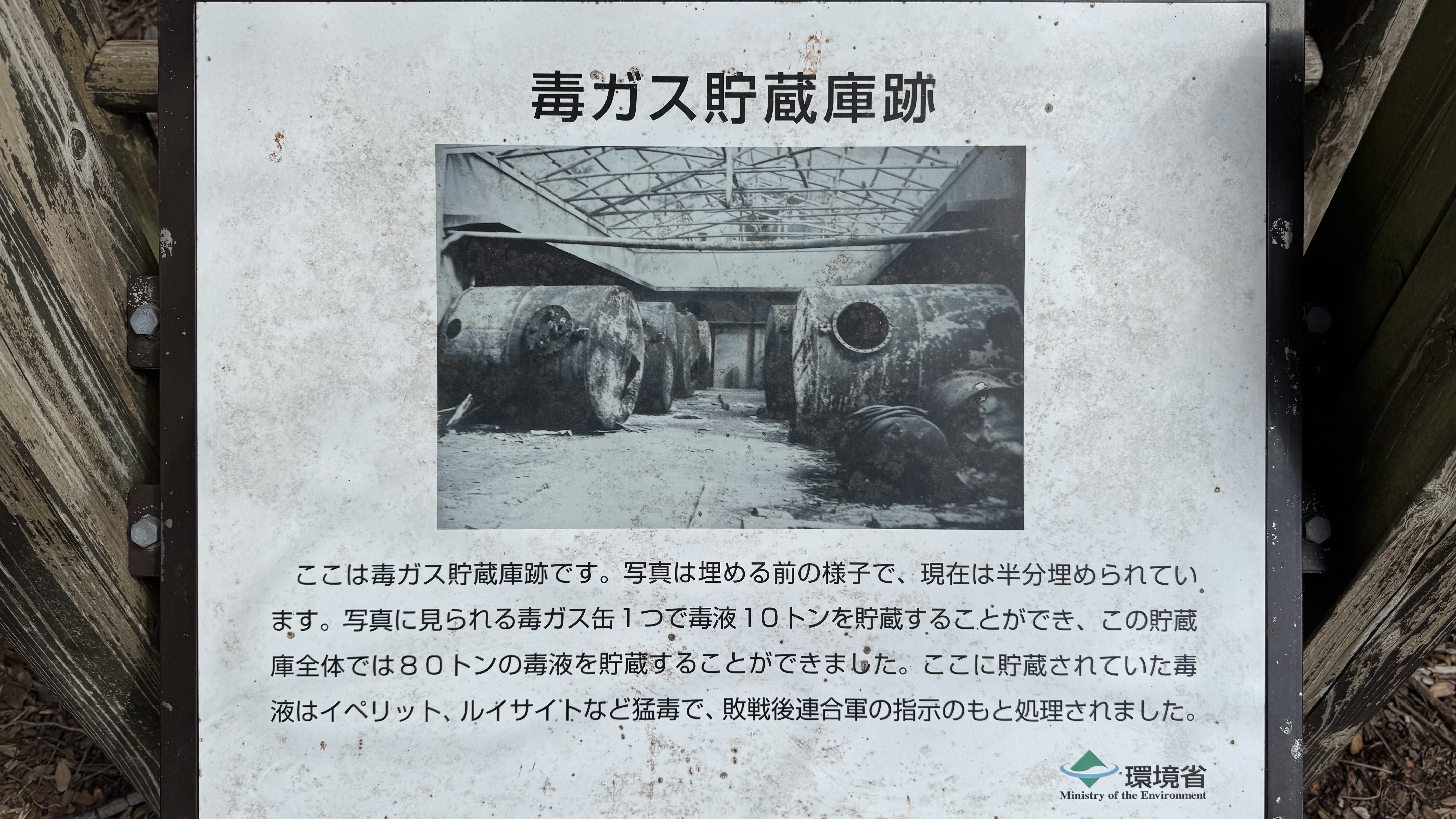
Throughout the island, there are “remains of poison gas storage facilities” where substances such as mustard gas were once stored. These come in various forms, ranging from sites where massive concrete foundations remain to structures that appear to have been carved directly into the mountainside. The interiors remain dimly lit to this day, with a chilly air lingering inside; the areas where parts of the walls have turned black are believed to be the result of the properties of the stored substances and the postwar disposal process.
【Overlap with the gun emplacement ruins】
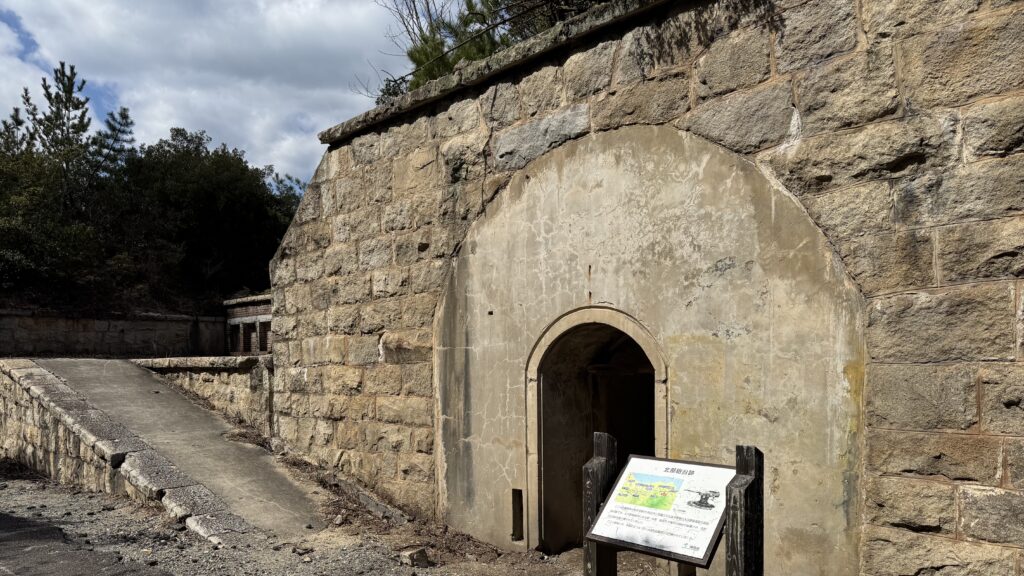
Okuno Island has a history dating back to the Russo-Japanese War era, before it became a poison gas factory, when gun emplacements were established there as part of the “Geiyo Fortress.” Remnants of these gun emplacements remain in the central and northern parts of the island, and there are records indicating that the barracks and other structures, after the fortress had served its purpose, were later repurposed as storage areas for products during the poison gas production period. The fact that a single island served dual purposes as a military facility across different eras also demonstrates the unique historical complexity of this island.
Against the backdrop of these crumbling concrete ruins, rabbits with soft fur bask in the sunlight. This striking contrast is a sight unique to Okuno Island, evoking a mysterious sensation where traces of human activity coexist with the vitality of nature within the same space.
Postwar Cleanup and Environmental Conservation: Okuno Island Poison Gas Museum
With the end of the war in 1945, poison gas production on Okuno Island ceased. The large quantities of chemical weapons remaining on the island were to be disposed of under the supervision of the occupying forces.
According to records, the disposal methods primarily involved dumping into the Pacific Ocean and the Seto Inland Sea, burying the materials in the ground, and incineration using flamethrowers and other equipment. To this day, regular soil and groundwater surveys conducted by the Ministry of the Environment and other agencies continue in parts of the island, and efforts to preserve the environment regarding these historical remnants are ongoing. While the safety of areas accessible to tourists is ensured, the fact that certain zones are fenced off and restricted to the public is a reality that extends from this history.
In one corner of the island stands the “Okuno Island Poison Gas Museum.” Inside, the museum displays parts of the machinery actually used to produce poison gas, thick rubber protective suits, and records of diaries and testimonies from the people who worked there at the time. This facility does not impose any specific interpretation or judgment; it exists solely as a collection of objective facts regarding “what took place here in the past.”
“Okuno Island Holiday Village” as a Place of Relaxation Today
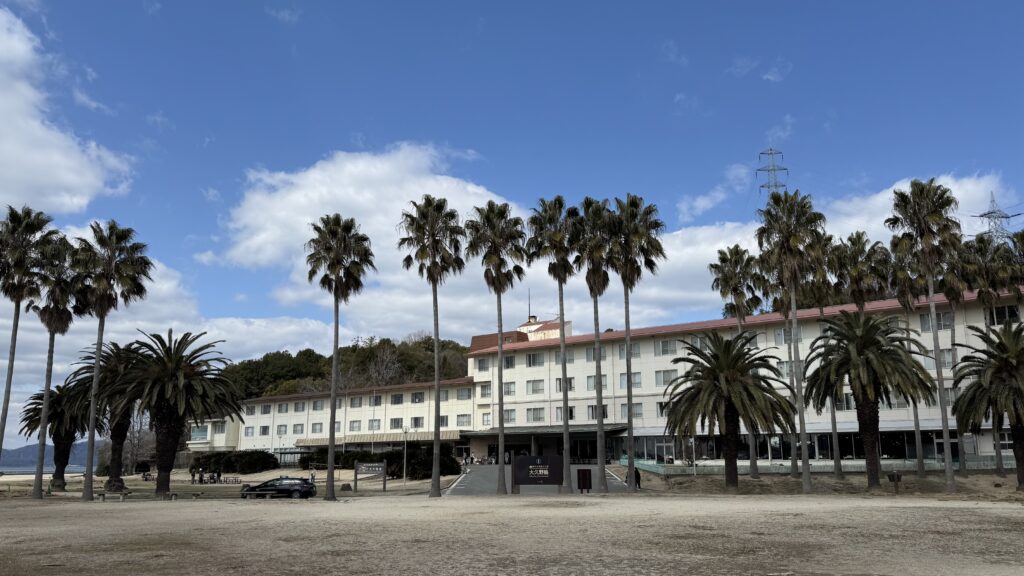
Despite its heavy historical burden, once postwar cleanup operations were completed, Okuno Island took on a new role. Designated as part of the Seto Inland Sea National Park, the resort facility “Kokumin Kyukamura” (now Kyukamura Okuno Island) opened in 1963 (Showa 38).
This marked the beginning of Okuno Island’s journey as a tourist destination. Since private vehicles are generally prohibited on the island, there is no noise from car engines or exhaust fumes, maintaining a very peaceful and clean environment.
Centered around lodging facilities, the island features the natural radium hot spring “Seto Onsen,” campgrounds, and a summer-only beach. Families relaxing on the lawn in front of the Kyukamura, tourists riding rental bicycles through the sea breeze—and rabbits spending their days leisurely, seemingly surrounding them all. These are all unmistakable, authentic scenes that define the island today.
Your Base in Hiroshima — Hotel Small World
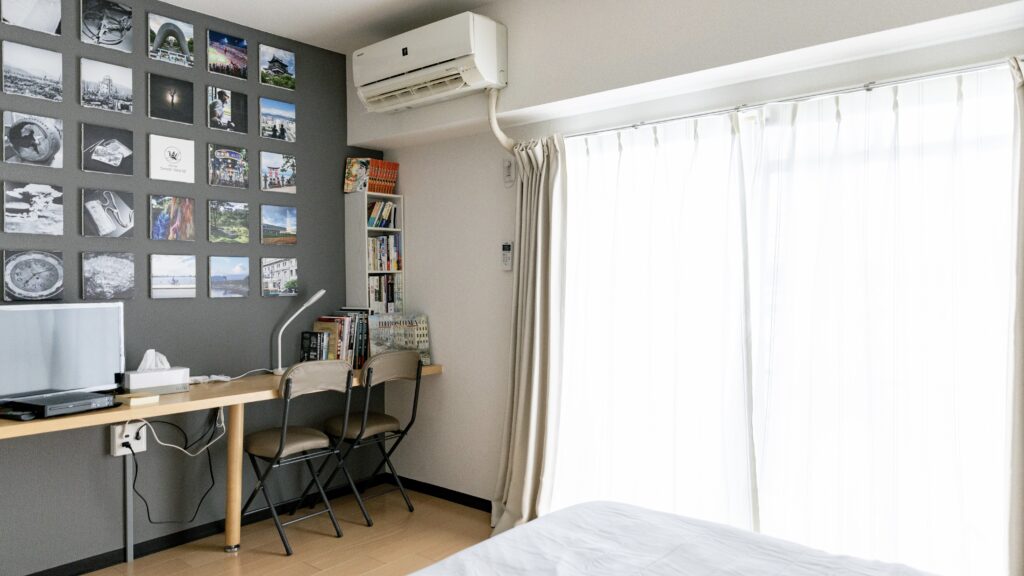
When exploring Hiroshima’s history and the scenery of the Seto Inland Sea, you can make Hotel Small World, located in Hiroshima City, one of your bases for your stay. Situated in the heart of the city, this hotel offers both easy access to tourist attractions and a tranquil atmosphere, making it ideal for a leisurely, stay-and-explore trip through Hiroshima.
Visit historical sites such as the Atomic Bomb Dome and Peace Memorial Park, and then expand your journey to the islands of the Seto Inland Sea. During a trip that allows you to experience the multifaceted charms of Hiroshima, you can spend a pleasant time here, quietly reflecting on your day.
〈Directions from Hotel Small World: How to Get to Okunoshima〉
If you’re heading to Okuno Island from Hotel Small World, first head to Tadanoumi Port, the gateway on the Honshu side.
① When using JR
Take the JR Kure Line from Hiroshima Station, and you’ll arrive at Tadanoumi Station in about an hour.
It’s about a 7-minute walk from Tadanoumi Station to the port.
② Taking the ferry
Take a ferry or passenger ship bound for Okuno Island from Tadanoumi Port, and you’ll arrive on Okuno Island in about 15 minutes while enjoying the scenery of the Seto Inland Sea.
Since vehicle access is restricted on the island, we recommend exploring at a leisurely pace on foot or by rental bicycle. As you circle the island feeling the sea breeze, you’ll encounter both the peaceful daily lives of the rabbits and the historical memories preserved in the concrete ruins.
Summary
When walking around OkunoIsland, we are inevitably confronted with both the cruelty and the gentleness of time.
The concrete ruins do not speak for themselves regarding their historical significance. What remains are only the “facts”: that large-scale facilities operated under the state’s decisions at the time, that weapons were manufactured there, and that people’s health was compromised.
Simply clinging to negative emotions from the past is not necessarily constructive. Rather than painting the past entirely with negative emotions, or conversely, covering it up with only beautiful natural scenery, we must accept both sides as they are—as facts.
It is crucial to maintain a stance that allows us to look squarely at historical records without remaining stuck there, but rather to apply the facts we have learned to build a peaceful future.
Walking along the coastal road, I see rabbits leaving tiny footprints on the very path where people in protective suits once passed. Whether during the era when poison gas was manufactured or now, as rabbits frolic, the gentle sound of the Seto Inland Sea’s waves continues to envelop this island, unchanged.


Recommend
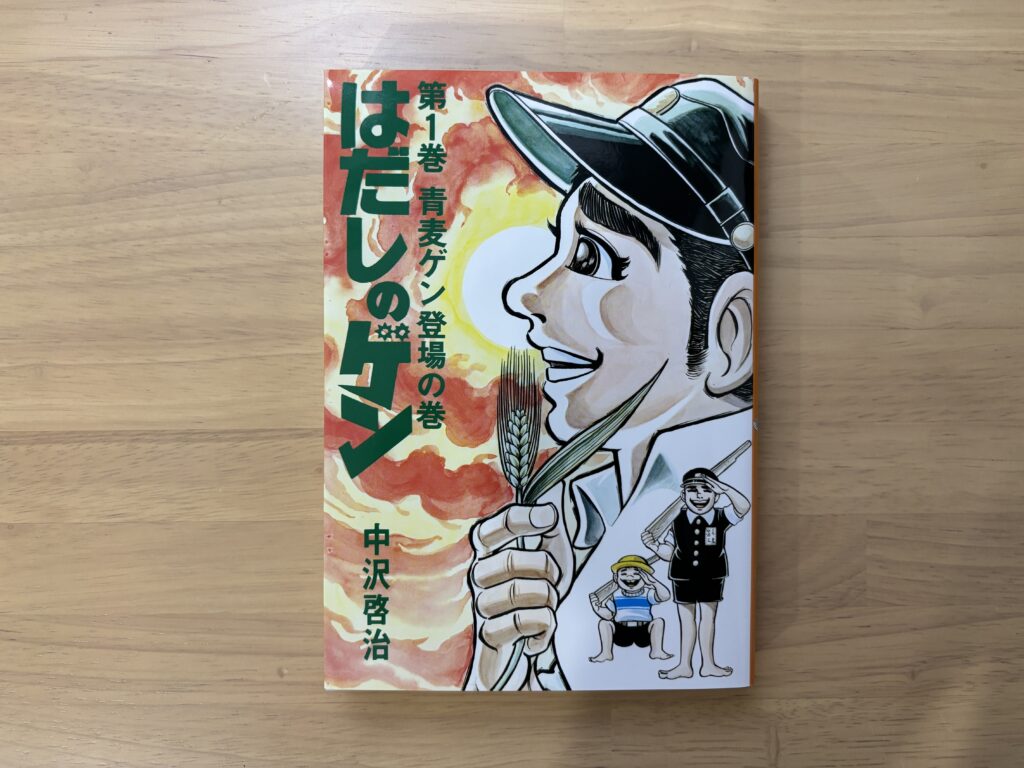
Learning About Hiroshima After the Atomic Bombing and the People Who Lived Through the Postwar Era Through Barefoot Gen
Here are some parking options, car-sharing services, and car rentals near Hotel Small World
What Is the Nagasaki Peace Memorial Ceremony? — A Prayer for Peace from “The Last City to Suffer an Atomic Bombing”